Title records
Incomplete or unclear chains of ownership.
ChangesWho can sign, and what can be mortgaged.An integrated advisory and project-structuring platform for redevelopment and development in Mumbai MMR. We help you see what a property can support, whether the project is viable, which structure fits — and then coordinate the specialists needed to deliver it.
Behind every redevelopment opportunity sit variables that can each change the economics. Left unresolved, any one of them can surface after commitments have been made.
Incomplete or unclear chains of ownership.
ChangesWho can sign, and what can be mortgaged.Approved plans, records and site rarely agree.
ChangesEntitlements, and what each member receives.Owners and members want different outcomes.
ChangesConsent, structure and timelines.Rules and permissions evolve mid-project.
ChangesBuildable area and premiums payable.Capital is conditional and priced on risk.
ChangesCost of funds — and whether work starts at all.Delivery risk compounds over a multi-year build.
ChangesCost, completion date and rent outflow.We connect these decisions before commitments become irreversible.
RedRiver One works at the intersection of land, housing societies, regulation, architecture, development economics, capital and construction — so the facts behind one decision are visible to everyone making the next.
We separate what is known from what is assumed — before anyone commits.
We separate documented rights and costs from assumptions, challenge optimistic projections and name the documents and approvals a decision needs.
These are alternatives to evaluate — not products to impose.
Every professional keeps their mandate and signature. We bring their work into one coherent project framework.
See who decides whatStructured data, scenario models and digital reporting — used only where they improve traceability, cost control or decision quality. Technology assists judgement; it does not replace it.
Confirmed against an authoritative source.
e.g. plot area per property cardStated in a document, not yet confirmed.
e.g. carpet area in an old agreementA working input — stated openly and tested.
e.g. sale rate for free-sale unitsA conclusion drawn from other inputs.
e.g. likely premium payableNamed, owned and scheduled for resolution.
e.g. outcome of a title searchEach discipline hands the next a defined output — so nothing moves forward on an assumption the previous stage could have tested.
Explore the full lifecycle →Property identity, ownership and rights, stakeholder objectives and current condition.
Hands overA documented baseline and the questions to answerTechnical, planning, legal, commercial, market and financial analysis — coordinated.
Hands overCredible scenarios, with downside casesSelf-redevelopment, JV/JD, development management and sharing models, compared.
Hands overA structure with explicit risk allocationArchitects, advocates, PMCs, engineers, contractors and vendors — assembled and governed.
Hands overA coordinated team, within defined scopeAn executable project translated into its financing requirements.
Hands overA lender-ready case; approval stays independentDocuments, decisions, procurement, cost, schedule and risk — connected.
Hands overOne continuously updated project viewThe tools behind those outputs — shown with examples from a society redevelopment. Select a step to explore.
Approved plan areas rarely match owner or member records. Title papers go missing. Occupation data is inconsistent. We reconcile the documents into one property and stakeholder baseline that flags exceptions before anyone signs.
OutputA baseline the project's advocates and architects can work from.
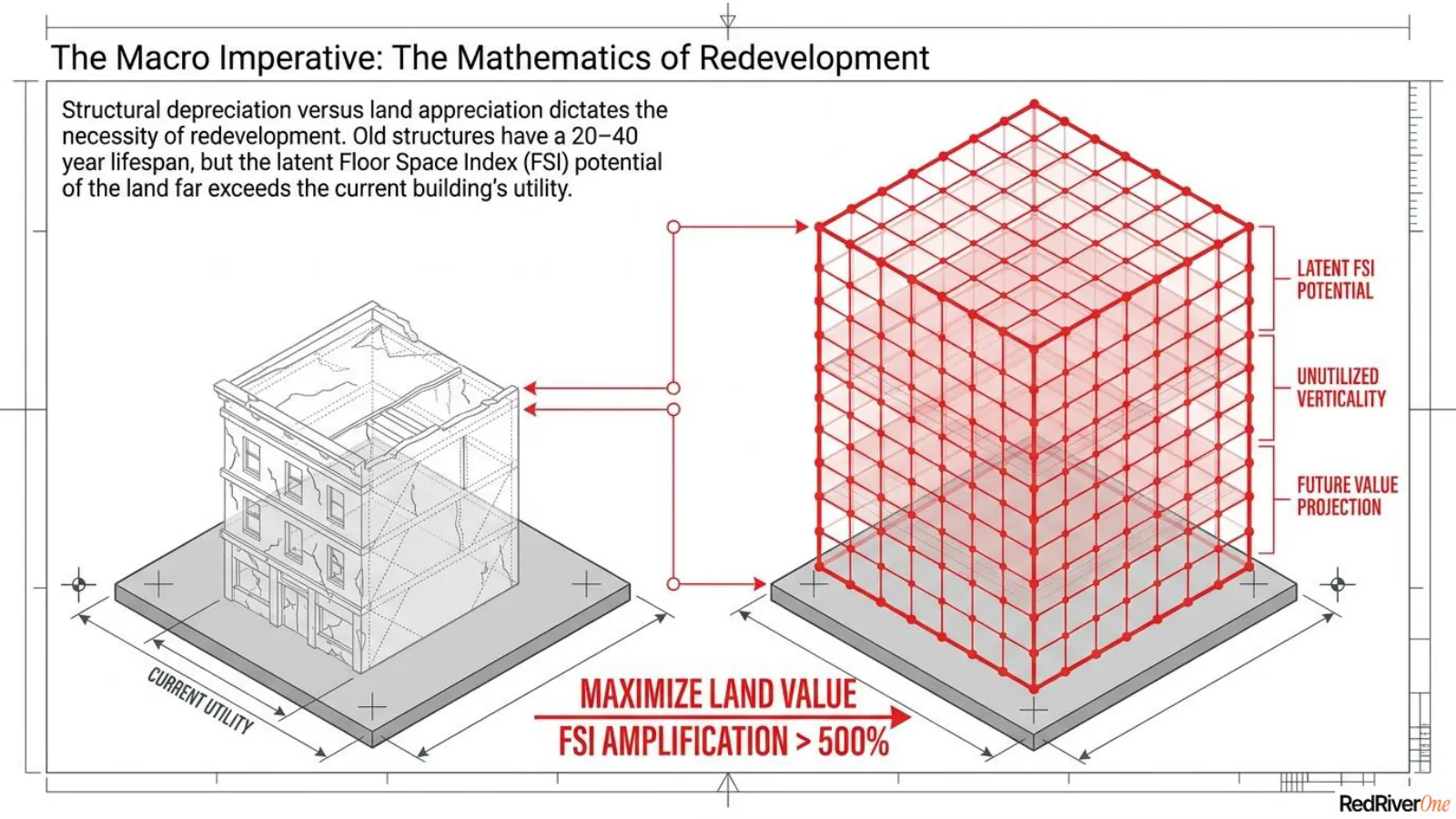
From gross plot potential we deduct statutory setbacks, then the rehabilitation requirement and amenities, then member or owner enhancement — what is left is the sale component that funds the project.
OutputA transparent bridge from plot area to saleable area.
Illustrative proportions
Stakeholders rarely want the same thing. Some want the largest home, some the smallest loan, some the fastest completion. Each option is modelled so everyone sees what it means for them.
A project must not only work on paper; it must show a credible ability to survive foreseeable downside conditions. We stress the plan before the lender — or the market — does.
The lowest quote is rarely the cheapest contract. We normalise bids across exclusions, liquidated damages, defect liability and performance security — so you see the real risk you are buying.
OutputA clear brief for client review and legal drafting by your advocates.
| Contractor A | Contractor B | Contractor C | |
|---|---|---|---|
| Contract price | ✓ | Lowest | ✓ |
| Spec. exclusions | — | Flagged | ✓ |
| Liquidated damages | ✓ | — | Weak |
| Defect liability | ✓ | ✓ | — |
| Performance security | ✓ | Missing | — |
The feasibility model becomes the baseline. Approved design, contracted cost, actual progress, funding and sales feed one view — every variance in cost or time updates completion, funding need and risk.
Expected versus actual sale prices and collections are tracked as they happen. At handover, every owner or member receives a permanent, version-controlled record of their home.
Each professional keeps their mandate and their signature. We bring their work into one framework — so a finding in one discipline is seen by every other.
DecidesDesign, and certifies plans.
We connectDesign options to cost, entitlement and stakeholder outcomes.
DecidesTitle and legal rights.
We connectDocument issues to the formal determinations they need.
DecidesStructural and technical feasibility.
We connectTheir findings to cost, schedule and risk.
DecidesCapital terms — independently.
We connectThe project to the case they need to assess.
DecidesHow the building gets built.
We connectProgress, cost and variance to one live view.
DecidesWhether, how and with whom to proceed.
We connectEvidence and alternatives to that final decision.
 RedRiverOne
Our role: coordination, analysis and structuring — subject to appointment and a defined scope. We do not certify designs, give legal opinions or lend.
One of India's densest and most varied development markets. Permissions, norms and commercial structures differ by location and project type — so we work project by project, not from a template.
Six kinds of stakeholders come to us at different moments. Find yours — each conversation starts with the property, its present stage and the decision to be made.
What members may receive, what it may cost, what governance it needs and how execution can be controlled.
Assess a society projectEvaluate development rights and commercial alternatives before committing to a developer, a land sale or a long-term agreement.
Evaluate your landTransparent assumptions, conditions precedent, project cost, sensitivities, funding requirement and risk allocation.
Discuss investment criteriaStructured partnerships that match development and delivery capability with suitable sites, stakeholders and capital.
Explore a partnershipWork with a commercial and financial coordination partner that makes development options comparable for your client.
Collaborate on a feasibilityA document-led process that surfaces issues for your opinion — without conflating commercial analysis with legal certification.
Join the professional networkIt can let a society retain the surplus a developer would otherwise earn — and it also hands the society the developer's responsibilities. Here is the framework and the route to test before deciding.
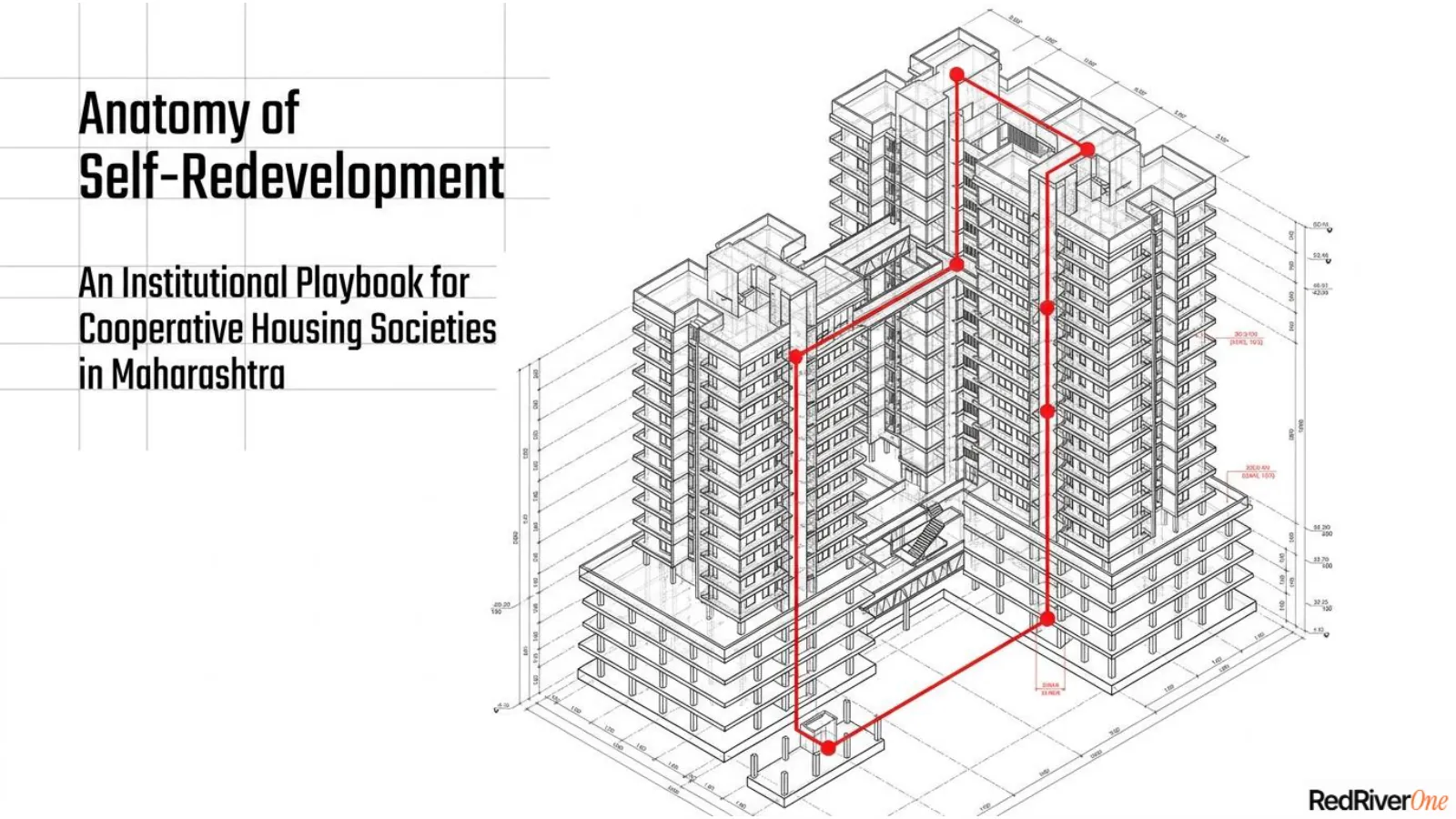
Maharashtra's self-redevelopment GR (13 Sep 2019) materially changes the economics for societies.
Indicative parameters from the applicable GR. Eligibility, quantum and timelines are subject to the prevailing regulations, approvals and lender assessment.
Section 79(A) procedure. 51% of members pass the preliminary resolution; 100% written consent is needed for the bank mortgage.
Architect / PMC, legal advisor, chartered accountant and contractor — vetted on track record and audited financials.
Surveys and a structural audit feed the project report. Members choose between larger homes and a larger corpus.
Around 55–60 NOCs routed through one window, within a mandated six-month timeframe.
A tripartite agreement between society, bank and contractor; funds flow through escrow against certified milestones.
A society vigilance committee and MahaRERA registration through to completion and the corpus.
Browse both decks right here. Want a copy for your managing committee, board or investment team? Leave your email and we'll send the PDF.
Straight answers to what societies, owners and partners ask us first.
Ask us something else →We help stakeholders understand what a property can support, test whether a project is viable, choose an appropriate commercial structure, and coordinate the specialists, capital and project controls needed to execute it — across Mumbai and the wider MMR.
None of these. We are an advisory and project-structuring platform that works across the interfaces between owners or societies, architects, advocates, engineers, PMCs, contractors and capital providers — and brings their work into one project framework.
No. Architects design and certify, advocates opine on title, engineers validate technical feasibility, lenders decide capital terms and contractors build. We make sure their work is decided on one consistent set of facts.
We translate an executable project into its financing requirements and support engagement with appropriate capital providers. Any financing remains subject to the lender's or investor's independent assessment and approval.
No. Self-redevelopment, joint development, development management, investor partnerships, area-sharing and revenue-sharing are alternatives to evaluate. The right one depends on the property, the stakeholders, their appetite for risk and the capital available.
Mumbai, Thane, Navi Mumbai, Kalyan-Dombivli, Mira-Bhayandar and adjoining locations in the Mumbai Metropolitan Region.
A short description of the property, its present stage and the decision you need to make. Documents such as the property card, title papers, approved plans or society records help — but they are not needed to start.